
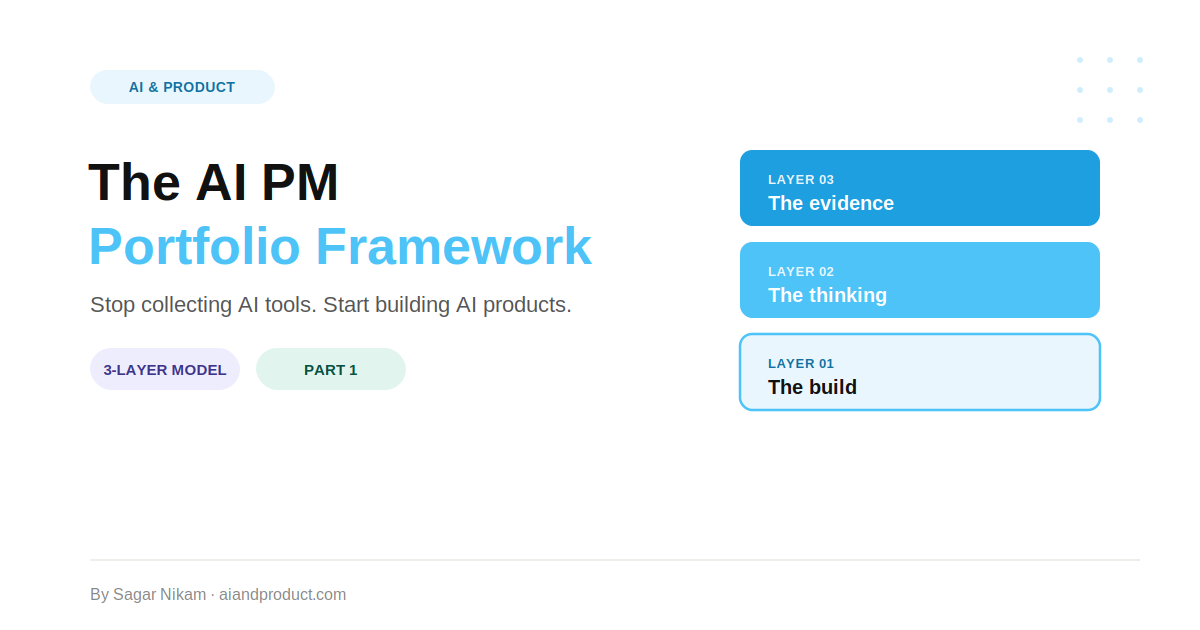
Stop collecting AI tools. Start building AI products with real users, real metrics, and real product decisions — documented for any interview.
- A 3-layer model to turn any AI build into a portfolio case study
- The 5 product-thinking questions every interviewer actually wants answered
- A checklist to assess if your current work qualifies as “AI PM experience”
The bar has shifted — again
“I use AI” was enough to stand out in 2023. By 2024, you needed to show you had actually built something. In 2025, however, interviewers are asking a third question — and most candidates don’t have an answer for it.
The question is not what you built. It’s whether you thought like a product manager while building it. If you’re still figuring out what the AI PM role actually requires, that’s the right place to start.
This framework gives you a repeatable system to close that gap. Moreover, it applies to every project you build from here on — not just your next one. Get the weekly version of these insights in the AI & Product newsletter.
The 3-Layer Portfolio Model
Every AI PM case study needs three distinct layers. Without all three, it’s a demo — not a product story. Furthermore, this mirrors how SVPG defines product work: discovery, delivery, and evidence of value are inseparable.
The AI prototype, tool, or feature you built — using any stack (Lovable, Claude, GPT API, n8n, etc.). Surprisingly, this is the least important part of your portfolio story.
Discovery, user research, and problem framing all belong here. In addition, every decision you made before writing a single prompt matters. This is where most candidates are weakest. If you want to go deeper, the best books on product discovery are a strong foundation.
Metrics, user feedback, and iteration decisions all count as evidence. Consequently, what you would do differently in v2 is just as important as what you shipped. This closes the loop and signals product maturity.

“In 4 cohorts of my course, the biggest gap I see isn’t technical — it’s that people skip Layer 02 entirely. They build something impressive, then can’t explain who asked for it.”
The 5 Questions Every Interviewer Wants Answered
For every AI project in your portfolio, you must answer these five questions clearly and without hesitation. They map directly to what the AI PM role demands day to day. Prepare them in advance — interviewers notice when you haven’t.
Name the specific user problem. “I wanted to learn AI” is not an answer. What pain were real people experiencing?
Name a real user segment. How many people did you interview? 5 well-structured interviews reveal more than 50 survey responses. What surprised you?
Every product decision involves a tradeoff. What did you cut? What did you prioritise — and why?
Pick one primary metric. “User satisfaction” is too vague. Instead, go specific: weekly active users, task completion rate, or time-to-value.
This question shows you’ve reflected on your learning. Interviewers love candidates who can critique their own work honestly.
What “Evidence” Actually Looks Like
You don’t need enterprise data. What you do need is documented product thinking. Here are six types of evidence that qualify — even for a side project. Teresa Torres’s continuous discovery framework is a useful model for collecting this habitually.
Six forms of evidence hiring managers respect
Even 5–10 interviews can document real pain points. Record the key quotes that shaped your decisions. Here’s how to run them well.
Define your metric before you launch. Even “10 users return more than once in week 1” is a real, measurable target.
A prioritised backlog with your reasoning. PRD format or a simple Notion doc both work. Think of it as a lightweight version of structured product discovery.
Show two versions. Test them with real users. Document what changed — and why — based on the results.
A structured log of user comments with your response: ship, defer, or deprioritise — plus the reason for each call.
One page covering: problem statement, options considered, decision made, and tradeoff acknowledged.
Early Adopter vs AI PM: The Actual Difference
Here’s how to audit your existing projects honestly. Use this table to identify the gaps before an interviewer does. Understanding what separates AI-powered from AI-enabled work is part of the same shift.
| Signal | Early Adopter | AI PM Portfolio |
|---|---|---|
| Built something with AI | Yes | Yes |
| Documented user research | No | Yes |
| Defined a success metric before launch | No | Yes |
| Can explain tradeoffs made | No | Yes |
| Has a v2 roadmap with reasoning | No | Yes |
| Knows the AI’s role vs the user’s role | Sometimes | Always |
| Can speak to failure modes of the AI | No | Yes |
Your 30-Day Portfolio Checklist
Use this to upgrade one existing project over the next 30 days. Alternatively, start a new one from scratch using these steps as your guide. Additionally, if you want a credential to go alongside your portfolio, check out the top free AI PM certifications worth doing in 2026.
-
Pick one problem area you’ve personally experienced or heard repeatedly from a specific user group.
-
Run 5 user interviews before writing a single prompt. Document the top 3 insights in a shared doc.
-
Write a one-page PRD: problem, user, success metric, scope, and what you’re deliberately NOT building.
-
Build an AI-powered prototype (Lovable, Claude, GPT API — any tool). Not sure whether to build a prototype or a POC first? Here’s the difference and when each makes sense. Aim for something testable within 1 week.
-
Test with 5 real users. Record what confused them. Note what you’d change immediately.
-
Document your decisions: what tradeoffs you made, what the AI handles vs what the user handles.
-
Write your v2 roadmap: 3–5 prioritised features with the “why” documented for each.
-
Package the case study: one Notion page or PDF covering all 5 portfolio questions with evidence links.
Don’t Just Build It — Ship It Publicly
A portfolio that only lives on your laptop is invisible. As a result, the PMs getting noticed aren’t necessarily building the most sophisticated products. Instead, they’re building in public, consistently. Browse the AI & Product blog for examples of how to write about AI PM work clearly.
Four channels to publish your work
Post a short update at every stage. Share when you finish interviews, when you ship v1, and when something breaks. The journey is the content.
A 600–1,000 word case study on Medium, Substack, or LinkedIn Articles is powerful. It shows product thinking, written communication, and self-awareness — all in one place. Subscribe to the AI & Product newsletter for weekly examples of PM writing that works.
A well-structured GitHub README or public Lovable link signals transparency. Pair it with a short paragraph explaining your product decisions — not just the code.
A cold DM with your case study as context isn’t self-promotion. It’s a conversation starter. You’re not asking for a job — you’re asking for a perspective. Jobs-to-be-done thinking applies here too: what job is the hiring manager trying to do when they read your message?
A simple weekly rhythm to stay consistent
Build your full AI PM portfolio in 5 live Saturdays
The 5-Week AI PM Course walks you through this framework end-to-end — with live coaching, peer review, and a job-ready portfolio you can present in any interview.
This is a free resource from AI & Product by Sagar Nikam. Get weekly AI PM insights at aiandproducts.substack.com. No affiliate links in this post.