
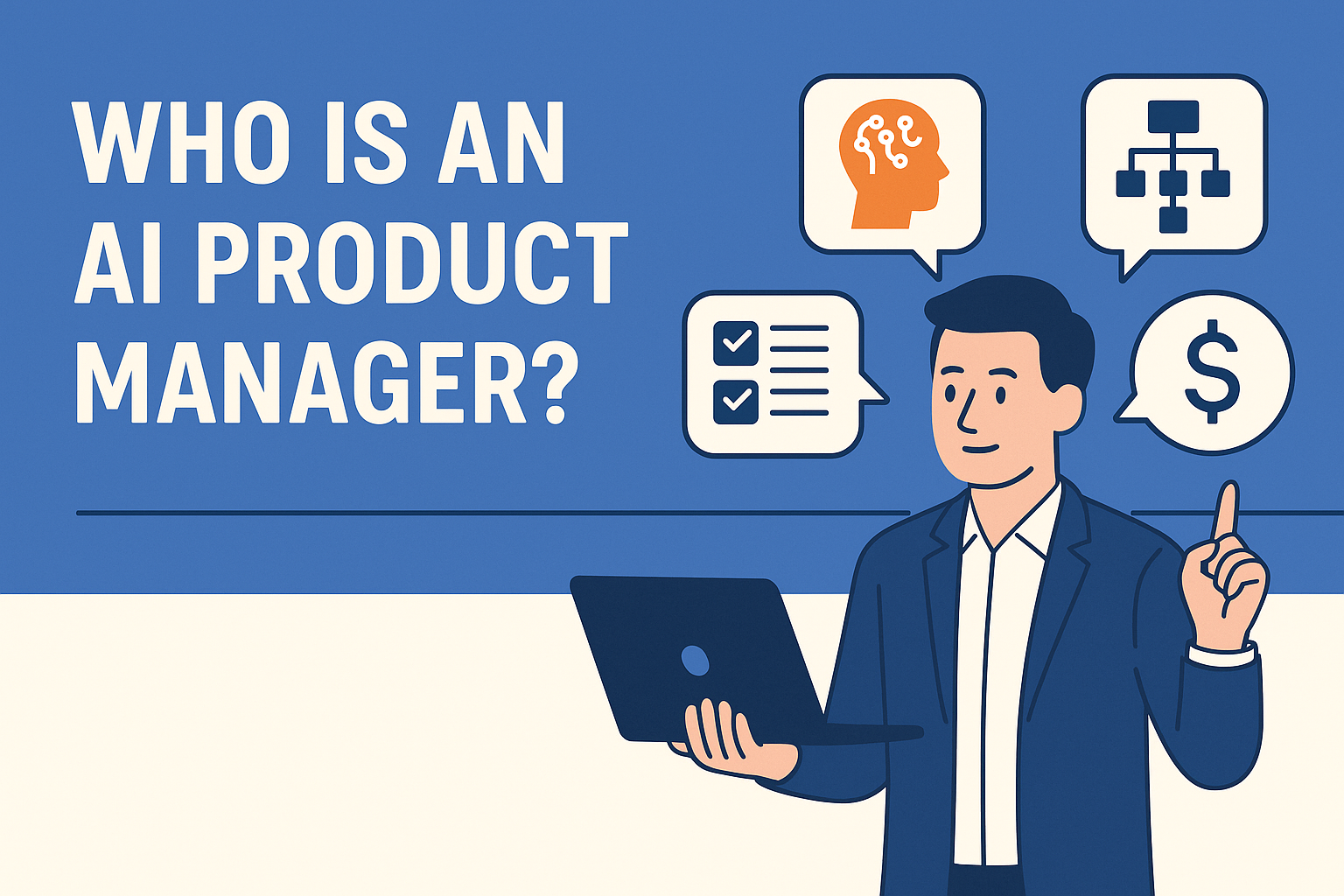
Learn what an AI Product Manager does, required skills, day‑to‑day tasks, career path, and salary ranges—plus strategic tips from someone building in this space.
In the era of generative AI and agentic tools, AI Product Managers are rising as critical players in tech teams. They bridge the gap between data science, engineering, user experience, and business strategy.
If you’re aiming to transition (say, from data analytics or general product management) or want clarity on what this role truly demands, this post is for you. Along the way, you’ll also see links to my deeper explorations, such as AI as a Feature vs AI as a Product: What Leaders Must Know and How to Choose the Right AI Product Management Certification.
1. What Does “AI Product Manager” Mean?
An AI Product Manager (AI PM) leads product development for AI‑enabled features, models, or full AI-powered products. The “AI” part adds complexity: your decisions must factor in training data, model behavior, drift, ethical risks, feedback loops, and infrastructure.
In many organizations, the AI PM functions as the translator between data scientists, ML engineers, UX designers, and stakeholders. You must understand both the technical and strategic dimensions of AI initiatives.
This role is distinct from traditional product management: you’re not only shaping features and roadmaps—you’re managing models, experiments, inference, and guardrails.
2. Core Roles & Responsibilities
Here’s a breakdown of key duties and responsibilities you should expect (and prepare for) as an AI PM:
| Area | Responsibilities / Tasks |
|---|---|
| Strategy & Vision | Define AI product vision and how it aligns with company goals |
| Roadmap & Prioritization | Prioritize AI features or model enhancements, balancing risk, impact, and cost |
| User Research & Metrics | Conduct user interviews, define metrics (precision, recall, error rates, user satisfaction) |
| Feature Design + Spec | Translate feature ideas into AI specs: model inputs/outputs, constraints, fallback logic |
| Data Strategy | Partner with data engineering to define training data, pipelines, feedback loops, annotation |
| Experimentation & Validation | Run A/B tests, evaluate model performance, monitor drift, iterate |
| Production & Infrastructure | Work with ML engineers to manage model deployment, versioning, autoscaling, rollback |
| Risk, Governance & Ethics | Mitigate bias, ensure explainability, define guardrails, privacy compliance |
| Cross-functional Leadership | Work with engineering, design, ops, legal, growth, marketing teams |
| Stakeholder Communication | Communicate roadmap, performance, trade-offs to execs and non-technical teams |
Tip: When planning AI features, always include fallback or safe-fail logic. Models can be unpredictable, and users need reliable behavior.
Many of these responsibilities echo those in traditional product roles, but the stakes are higher when model decisions influence UX, business outcomes, or ethics.
3. Skills, Tools & Mindset
To succeed as an AI PM, you need a blend of technical, product, and human skills.
Technical & Analytical Skills
- Basic understanding of ML / AI concepts (supervised vs unsupervised, overfitting, bias, embeddings)
- Data analysis (SQL, Python, dashboards)
- Experimentation & metrics design
- Familiarity with ML infrastructure (model versioning, serving, monitoring)
- Working with data pipelines, feedback loops, and annotation systems
Product & Execution Skills
- Strong prioritization & roadmap design
- User-centric thinking in ambiguous contexts
- Writing clear functional specs
- Ability to break down complex model tasks into manageable experiments
- Risk mitigation and fallback strategy
Soft / Leadership Skills
- Communication across technical and business stakeholders
- Decision-making under uncertainty
- Ethical reasoning and bias awareness
- Persuasion & negotiation
- Empathy for users (especially when AI fails)
Tools You’ll Likely Use
- Analytics & BI tools (Looker, Tableau, Metabase)
- Experimentation platforms (Optimizely, internal A/B systems)
- Model monitoring & observability (e.g. Datadog, MLflow)
- Version control & CI/CD (Git, Jenkins)
- Annotation / labeling tools
- Collaboration & roadmapping tools (Notion, Jira, etc.)
4. Career Levels & Progression
Here’s how the AI PM path often unfolds:
- Associate / Junior AI PM: Focus on one feature or small agent, under mentorship
- Mid-level AI PM: Own entire AI modules or domain (e.g. recommendation, personalization)
- Senior / Lead AI PM: Define AI roadmap, lead product teams, influence strategy
- Director / Head of AI Products: Oversee multiple AI product lines, set vision, manage P&L
At higher levels, you shift from “making features work” to “defining which AI domains to pursue, balancing risk & ROI.”
5. Salary Ranges & Compensation
Below are market ranges and benchmarks (2025) — note these vary greatly by geography, company maturity, and scope.
- In the United States, the average AI Product Manager salary is around $181,000/yr according to Glassdoor. Glassdoor
- Dovetail reports top ranges between $150,000 to $234,000 for AI PMs, depending on responsibility level. Dovetail
- Interview Kickstart lists similar figures: base ~ $155,765 with ranges from $126,000 to ~$185,000. Site Title
- For AI startup roles, salaries vary more widely (some from $65,000 up to $252,000) depending on stage and equity. Wellfound
- At AI-native companies (e.g. C3.ai), PM compensation can move higher (e.g. $280K up to $398K) in senior tiers. Levels.fyi
Other compensation components often included:
- Equity / stock / options — especially in early-stage or AI companies
- Bonus / performance incentives
- Benefits & perks — remote work, health, professional development
- Non-monetary rewards also matter: AI roles are statistically more likely to include perks like remote flexibility, parental leave, etc. arXiv
Geographic & company impact:
An AI PM in Silicon Valley or New York will often command a much higher package than similar roles in smaller cities. Similarly, a role at a Fortune 500 or AI-first company will likely pay more than in traditional industries.
6. How to Transition / Position Yourself
If you’re planning to become an AI PM, here are quick strategies:
- Build AI Adjacent Experience
- Work on data, analytics, ML projects in your current role
- Volunteer for AI feature development in your team
- Learn & certify smartly
- Take a reputable AI PM certification (but choose wisely — see my guide: How to Choose the Right AI Product Management Certification)
- Checkout AI PM Mastery with Job-ready Portfolio – a 5 week Cohort style course by Sagar Nikam
- Build hands-on projects and experiments
- Bridge your domain
- Be domain-savvy (e.g. in your industry) and articulate use cases where AI adds leverage
- Write about product + AI intersections (for instance, using insights from my article AI as a Feature vs AI as a Product)
- Network & showcase
- Attend AI / product communities, speak, write
- Showcase small AI side-projects or prototypes
- Go from feature → product mindset
- Learn to think about systems instead of isolated features — see the leap strategy in Escaping the AI “POC Swamp”
- Understand how AI value transitions from experiments to full features
7. Why AI PMs Are Increasingly Vital
- AI is not just a feature — it’s becoming a platform layer in many product stacks.
- Teams need people who can manage models like products, not experiments.
- Companies are now expecting AI to deliver measurable business outcomes — needing leadership roles that understand both data science and market mechanics.
- As AI models get more autonomy (agentic systems), product complexity increases exponentially, requiring specialized leadership.
Conclusion
An AI Product Manager role blends the art of product leadership with the science of data and models. It’s a path for people who love navigating ambiguity, engineering trade-offs, user impact, and strategic vision — all under the hood of AI.
If you’re serious about stepping into this role:
- Start building hands-on AI features
- Sharpen your technical literacy + product judgment
- Leverage trusted frameworks (see my blog on certifications)
- Write, prototype, and network — digital credibility is powerful
About Author: Sagar Nikam – AI Product Leader
Sagar Nikam is an AI Product Manager, mentor, and creator with a passion for building AI-native products that solve real-world problems. He has mentored over 1,000 students to transition into high-impact roles across tech, product, and AI — earning 5-star ratings on platforms like Udemy and Topmate.
Sagar hosts AI Product Management Mastery with a Job-ready Portfolio as 5 5-week cohort that covers AI concepts and tools, Product Management techniques and frameworks, and tools like N8N, Build44, OpenAI, Gemini
Sagar writes deeply on the intersection of AI, product strategy, sustainability, and the future of work.
Follow on