
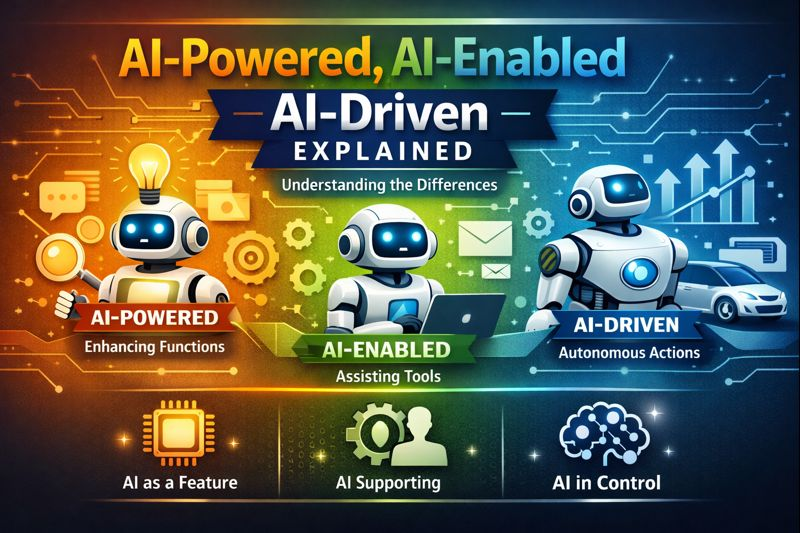
Artificial Intelligence (AI) buzzwords are everywhere — especially in product descriptions. Phrases like AI‑powered, AI‑enabled, and AI‑driven get tossed around so often that their real meanings can get fuzzy. But if you want to communicate clearly and boost search visibility, it’s crucial to understand the differences — and when to use each term for maximum impact.
Let’s break down the most common AI terms and help you pick the right wording for your product descriptions, marketing pages, and SEO content.

What Does “AI‑Powered” Really Mean?
Definition:
When something is AI‑powered, it means the product or feature uses artificial intelligence to enhance or operate a core function. AI here plays a central role, but it doesn’t necessarily run everything autonomously — it fuels key features. Medium+1
Usage Example:
- AI‑powered recommendation engine
- AI‑powered search results
- AI‑powered image tagging tools
When to Use It:
Use AI‑powered when you want to highlight that AI significantly improves functionality — but human control or oversight still matters.
What Does “AI‑Enabled” Mean?
Definition:
AI‑enabled means that AI is added to a traditional system to improve performance, but AI is not the core requirement for the product to function. It’s like a smart sidekick. Medium+1
Usage Example:
- AI‑enabled CRM analytics
- AI‑enabled email categorization
- AI‑enabled spelling and grammar suggestions
When to Use It:
Pick AI‑enabled when your product still works without AI — but AI features make it smarter, faster, or more efficient.
What Does “AI‑Driven” Imply?
Definition:
AI‑driven signifies that AI makes decisions, guides workflows, or directs outcomes with minimal human input. AI isn’t just a helper — it steers the ship. Key Business Accountants+1
Usage Example:
- AI‑driven autonomous navigation
- AI‑driven fraud detection systems
- AI‑driven real‑time bidding engines
When to Use It:
Use this term when AI actively drives key processes, especially in autonomous or self‑learning contexts.
Comparing the Terms: Quick Snapshot
| Term | AI’s Role | Human Involvement | Example |
|---|---|---|---|
| AI‑Enabled | Enhances existing tool | High | AI‑enabled analytics in dashboards |
| AI‑Powered | Core feature supported by AI | Medium | AI‑powered content suggestions |
| AI‑Driven | AI directs decisions | Low | Autonomous AI systems |
| AI‑Assisted | AI assists human work | Very high | AI‑assisted writing tools |
AI‑Assisted vs. AI‑Driven — Spotting the Difference
While AI‑assisted and AI‑driven both involve AI, there’s a key distinction:
- AI‑Assisted: AI helps humans do better or faster work — humans lead. Medium
- AI‑Driven: AI leads decision‑making and actions — humans oversee or monitor at best. thevirtualbusinessschool.com
For example, a proofreading tool that suggests edits is AI‑assisted. A self‑driving car that chooses routes and avoids obstacles is AI‑driven.
Why Choosing the Right Term Matters
1. Accurate Communication:
Using the correct AI label helps users understand what to expect. Saying a tool is AI‑driven when it’s mostly human‑led can mislead audiences.
2. SEO & Product Visibility:
Search engines and customers are getting smarter. Accurate AI descriptors help match user intent — improving rankings and reducing bounce rates.
3. Builds Trust:
Transparent descriptions prevent disappointment and reinforce credibility in your product messaging.
Practical Guidelines for Copywriters & Marketers
👉 Ask yourself:
- Does the product rely on AI to function? → If yes, consider AI‑powered.
- Is AI just enhancing an existing tool? → Then AI‑enabled fits best.
- Is AI making decisions autonomously? → Use AI‑driven.
- Is AI supporting human work? → Choose AI‑assisted.
Using clear, accurate terms not only improves user understanding but also helps search engines correctly index your content — strengthening SEO performance.
Wrapping Up
AI terminology may seem like marketing fluff, but each term has a specific meaning and role in communicating product capability. Understanding AI‑enabled, AI‑powered, and AI‑driven — and when to use them — makes your product copy more precise, SEO‑friendly, and trustworthy.
Other AI PM Resources:
- AI as a Product vs AI as a Feature
- 5 Step AI POC Framework
- Product Faculty – Maven – AI Product Management Certification Review
- Live Cohort Course – AI PM with Job-Ready Portfolio – https://aiandproduct.com/
- Newsletter – https://aiandproducts.substack.com/
- YT Channel – https://www.youtube.com/@sagarnikam136