
Imagine you lead development of a SaaS tool and the board asks: “Can we just add a chatbot?” You might say yes — but is that really building an AI product? Or just bolting on a feature?
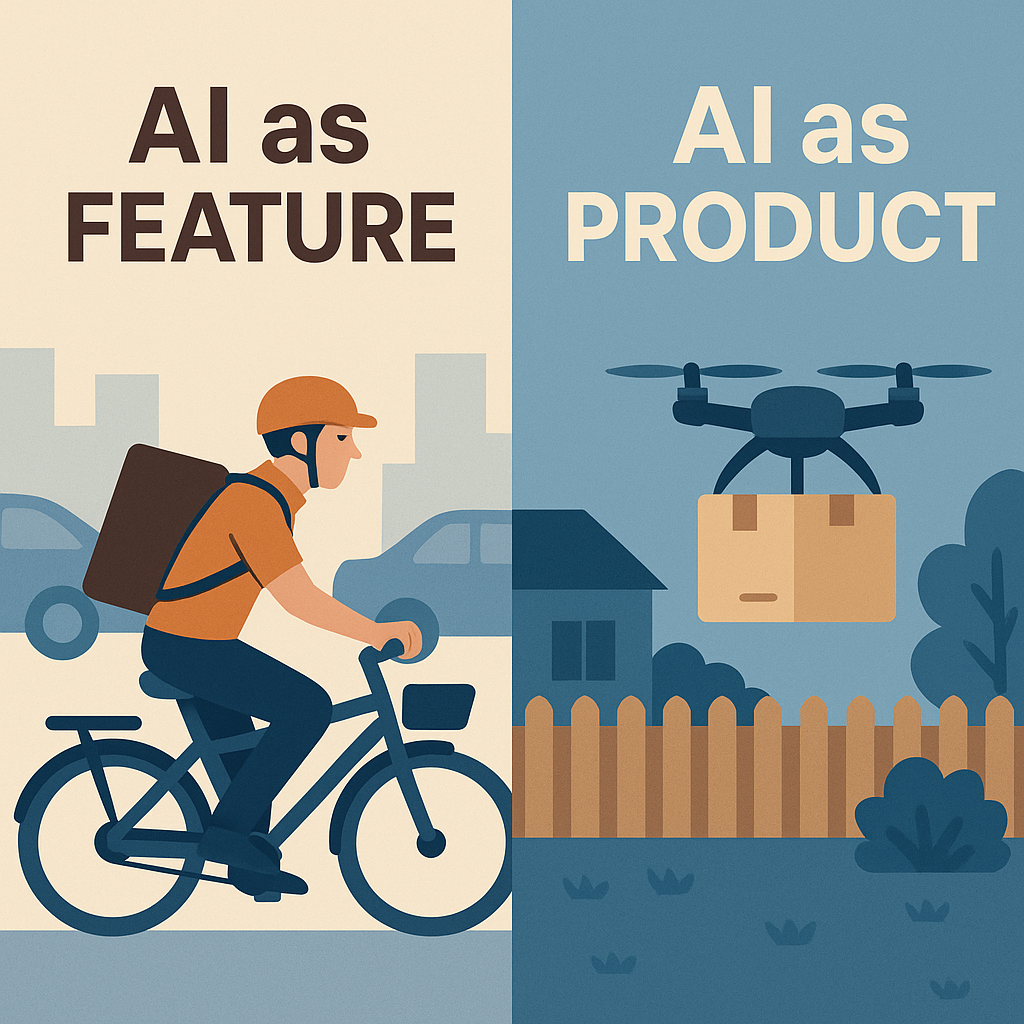
In today’s AI arms race, many organizations conflate AI as a feature and AI as a product. The difference matters—for investment, roadmap, technical architecture, risk, and go-to-market.
This article demystifies the line between AI as a feature vs AI as a product, helps you recognize where your architecture lies today, and gives a framework for deciding where you should aim.
1. Definitions & Distinctions
What Is “AI as a Feature”?
- An AI capability embedded inside a broader product
- Enhances or automates a single component of the user workflow
- Doesn’t change the core value proposition or business model in itself
For example: auto-complete/smart suggestions in a writing tool, or a recommendation engine in an e‑commerce dashboard. These are “features” layered into the core product.
What Is “AI as a Product”?
- The AI itself is the core offering
- Customers purchase the intelligence or model directly (often via API, SaaS, or white-label)
- Product logic, support, infrastructure, and business model center around the AI
Examples include language models (ChatGPT), autonomous agents, or analytics-as-a-service platforms.
It’s Not Always a Binary Choice
Many successful products evolve along a continuum:
- Start as a feature, gain traction
- If the AI component becomes mission-critical for users, spin it off as a standalone product
- Some products remain hybrid: a base product + a “premium AI module”
2. Strategic Trade-offs & Decision Dimensions
Here’s how the two approaches compare across key dimensions:
| Dimension | AI as Feature | AI as Product |
|---|---|---|
| CapEx & R&D | Moderate; incremental investment leveraging existing architecture | High; requires dedicated model development, infrastructure, versioning |
| Go-to-Market | Sell into existing customer base; upsell | New sales cycles, new buyer personas, separate branding & positioning |
| Differentiation & Moat | Easier for competitors to replicate | Harder to copy if the model/data is proprietary, giving defensibility |
| Technical Risk | Bounded use cases, fewer edge conditions | High — generalization, hallucination, drift, scaling fail cases |
| Data & Feedback Loops | Internal, controlled data flows | External usage, broader data ingestion, version control, model monitoring |
| Operational Overhead | Less: fewer SLAs, model updates, support calls | More: logging, retraining, rollback, observability, alerts |
These trade-offs guide your strategic posture. Treating AI “just as a feature” when it deserves product status often leads to underinvestment or muddled expectations. Conversely, launching a full AI product prematurely can sink resources.
3. Real-World Use Cases & Examples
AI as a Feature
- Apple Intelligence / Siri Enhancements: Apple’s approach demonstrates embedding generative features loosely into OS/apps rather than selling them as separate products. WIRED
- Recommendation Engines & Personalization: Spotify, Netflix, Amazon use AI features to power product suggestions, but the app is not sold as an AI tool.
- Smart Compose / Autocomplete: Google’s email “Smart Compose” adds value to Gmail as a feature.
AI as a Product
- Chatbots & LLM Platforms: ChatGPT, Claude, or Bard are AI-first products.
- Autonomous Agents / AI Assistants: Autonomous tools that handle multi-step tasks (e.g. booking travel, research) are AI products.
- Model-as-a-Service / Analytics APIs: Platforms that offer predictive analytics, anomaly detection, or inference engines as a standalone API.
Blended / Evolving Models
- Salesforce + AI Layer: Many enterprise SaaS platforms embed agentic AI modules atop core software, sometimes evolving into standalone offerings.
- Feature turned product spin‑outs: A feature begins inside a product; once usage and strategic value justify, it transitions into its own roadmap and branding.
- “Invisible AI” in internal tooling: Some AI features begin internal only—if mature, they may externalize into commercial product lines.
4. Guiding Principles for Choosing Your Path
Here’s a decision framework leaders can use:
- User Value & Experience
Does the AI component deliver standalone value to customers? Or is it merely a convenience inside a bigger workflow? - Market & Buyer Readiness
Are target customers ready to buy “intelligence” separately? Do they understand AI value independent of the full product? - Data Maturity & Access
Do you have sufficient, clean data? Are feedback loops in place? Do users generate enough volume to support model training? - Technical & Operational Capacity
Can your team support model lifecycle operations: versioning, drift detection, rollback, scaling? - Strategic Fit
Does launching an AI product align with your company vision, brand, and core domain? - Risk & Governance
As AI becomes a standalone product, scrutiny increases: explainability, bias, privacy, regulatory risk.
If most answers lean toward “yes,” pursuing product status is justified. If not, remain as a feature, but architect modularly with an eye to spin out later.
5. Implementation & Transition Strategy
If your roadmap aims to evolve a feature into a full product:
- Design modularly from day one — isolate model interfaces behind APIs
- Use feature flags & A/B testing to measure viability
- Instrument usage & signals to detect when the feature becomes mission-critical
- Carve out product teams when spin-out is warranted (separate metrics, personas, roadmap)
- Invest in infrastructure early: logging, monitoring, retraining pipelines, rollback, drift detection
- Educate stakeholders & users about boundaries, fallback logic, reliability expectations
- Stick to incremental launches — start small, validate in narrow verticals, iterate
6. Pitfalls, Misconceptions & Risks
- “AI washing” / overhype — claiming AI involvement when functionality is trivial or gimmicky Wikipedia
- Half-baked features that frustrate users “Nothing irks me more than half-baked ‘AI features’ introduced into otherwise well performing products that you cannot turn off or disable.” Reddit
- Lack of monitoring & model drift — features degrade over time if not maintained
- Overextending scope — trying to make every feature an AI product
- Underestimating support burden — users expect SLAs, explainability, safety when AI is productized
- Failing to articulate value difference — if customers don’t grasp why “AI as product” is special, adoption will lag
Conclusion
Distinguishing AI as a feature from AI as a product is not just semantic — it’s strategic. The choice shapes your investments, architecture, go-to-market, and risk exposure.
Product leaders should evaluate each AI component through a lens of value, maturity, and readiness. Start where you are; if a feature justifies standalone status, spin it out. But don’t pretend every AI addition needs to become a product.
Actionable next step: Pick one AI-enabled feature in your roadmap. Assess if it could justify a standalone offering. What would it take — data, infrastructure, usage — to make that leap?
Continue learning:
AI PM Blog & Resources ·
AI PM Mastery Course ·
Join the Newsletter
About Author: Sagar Nikam – AI Product Leader
Sagar Nikam is an AI Product Manager, mentor, and creator with a passion for building AI-native products that solve real-world problems. He has mentored over 1,000 students to transition into high-impact roles across tech, product, and AI — earning 5-star ratings on platforms like Udemy and Topmate.
Sagar hosts AI Product Management Mastery with a Job-ready Portfolio as 5 5-week cohort that covers AI concepts and tools, Product Management techniques and frameworks, and tools like N8N, Build44, OpenAI, Gemini
Sagar writes deeply on the intersection of AI, product strategy, sustainability, and the future of work.